
Date:9 October 2025
Inhalt Abschnitte
- ● What’s new in EAT-Lancet 2.0?
- ● Digging beneath the surface
- ● Conflicts of interest: Flora Power
- ● Ungrounded justice
- ● Net-zero dogma
- ● Aspirations Without Economics
Von Rob Verkerk PhD, Gründer, Geschäftsführer und wissenschaftlicher Direktor
DIE TOPLINIE
- Same recipe, new wrapper: Dietary recommendations for EAT-Lancet 2025 barely shift from 2019—mostly re-labels and rounding. It still pushes a one-size-fits-all “planetary” diet that sidelines regenerative agriculture, bio-individuality, cultural diversity, and metabolic needs
- Evidence-light, model-heavy: The report leans on modelling and associative epidemiology while downplaying real-world evidence, nutrient density, and risks of nutritional inadequecies (e.g., sodium and animal-sourced foods)
- From advice to control: The new PHD index is a policy tool that can be tied to procurement, guidelines, ESG scoring—and potentially even taxes or penalties—moving diet from personal choice to compliance metrics
- A better path exists: Regenerative, seasonal, regional and culturally rooted diets—measured by real health outcomes (metabolic markers, nutrient sufficiency, resilience) rather than top-down indices—offer a more effective, ethical route to human and planetary health.
Some of you may remember that when the EAT-Lancet Commission came out with its Planetary Health Diet (yes, PHD) back in 2019 (‘Food in the Anthropocene: the EAT–Lancet Commission on healthy diets from sustainable food systems’), we lambasted its efforts—and we weren’t alone.
According to a report recently published by the Changing Markets Foundation, around 100 high profile social media influencers tore into the 2019 report, including pro-meat/paleo docs Shawn Baker and Ken Berry, as well as keto diet advocate Nina Teicholz. Instead of engaging them in dialogue, the trick now seems to be to give them a name that will serve to mute their anticipated squeals on publication of the 2025 report. They’re not “conspiracy theorists”, “far right” or “anti-vaxxers”. No, they (we) have a new name of shame: “mis-influencers”.
As soon as the 2019 report was published, and before I realised I might become a “mis-influencer”, I worked feverishly to understand where EAT-Lancet was going given my background spanning both health and agricultural sustainability. The end product was what I still believe may have been not only the first, but also the most comprehensive, rebuttal of EAT-Lancet’s one-size fits all approach. I argued the EAT-Lancet Commission’s approach failed on nearly every count: nutritionally, scientifically, socially and environmentally.
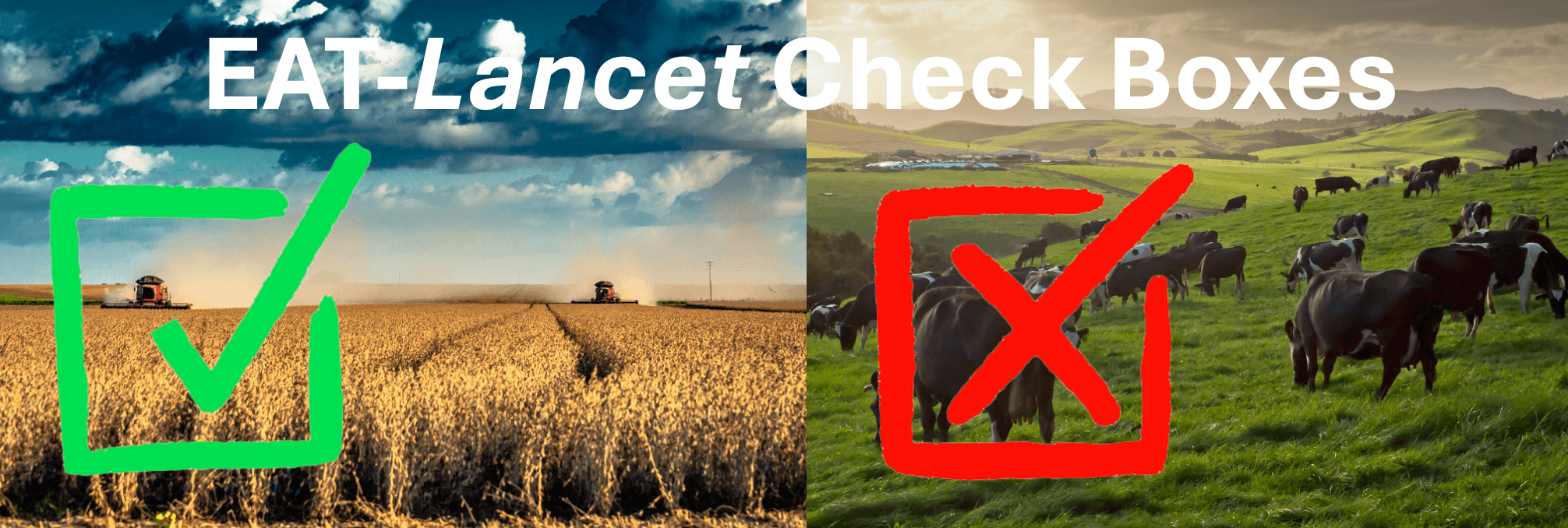
The only tick in the box I’d have been happy to check for EAT-Lancet 1.0 was that it was a prime example of desk-based science unrelated to the real world that serves to propagate a specific narrative, in this case, that ruminant farm animals are the ultimate scourge, and that the mainstream climate change narrative is unassailable and the most important issue of our time.
>>> Download ANH’s rebuttal of the 2019 EAT-Lancet report
Clearly in recognition of at least a few of the EAT-Lancet 1.0 shortfalls, the EAT-Lancet Commission has seen fit to issue version 2.0. Like version 1.0, the work has been chaired by Profs Walter Willett and Johan Rockström but there is a new co-chair, Shakuntala Thilsted, a UN expert in aquaculture. Some 70 experts from six continents contributed.
What’s new in EAT-Lancet 2.0?
We were particularly scathing about the original report’s lack of dietary flexibility, and with a modicum of applause, we welcome EAT-Lancet 2.0’s shift from a single “universal diet” to a more explicitly flexible planetary health diet (PHD) within ranges. They’ve gone on to add a full justice/equity pillar that includes everything from fair wages to healthy food access. They’ve also expanded planetary boundaries to all nine with food-system shares, and they’ve upgraded the modelling approach to create a PHD adherence index. Yes, a mechanism to assess compliance, initially at national and regional levels. But who is to say this couldn’t be the precursor to the tracking of individuals and even a mechanism to impose additional taxes or restrictions on individuals based on their degree of compliance or non-compliance?
The Commission claims version 2.0 delivers larger health gains and an improved global carbon footprint, while offering more nuance on animal-source foods (system-specific risks, circularity). With an audible sigh of relief we can inform you that the authors have at least accepted that Ultra-Processed Foods (UPFs) are problematic and they rightly advocate for minimally processed foods. The trouble is that their obsession with wholegrains as staples continues with no apparent recognition of the trouble this causes with overuse of herbicides like glyphosate, simplification of agro-ecosystems through monoculture and soil erosion, not to mention, the continued exposure of billions of humans who are sensitive to, or intolerant of, gluten-containing grains that play havoc with their guts, microbiomes and immune systems.
Our 2019 concerns included:
- one-size-doesn’t-fit-all (e.g., lack of cultural sensitivity, there were no options for regional ‘tailoring’)
- continued demonisation of livestock farming without adequate scientific basis
- over-reliance on evidence from industrialised farming systems
- risks of nutritional inadequacies
- policy overreach
- impacts on agricultural livelihoods (especially smallholders), and
- failure to recognise environmental benefits of regenerative or agro-ecological farming
Unfortunately, version 2.0 has done little to change any of these big issues. Yes, there are some adjustments that are in the right direction, but in many key areas there is no substantive change.
For example, version 2.0 softens the universalism and adds justice diagnostics, but it still orients policy toward population-level dietary shifts, strong levers, and net reductions in consumption of ruminant animal products. It recognises nutritional inadequacies may occur among vulnerable groups but it answers this not by increasing the nutrient density of the diet but by suggesting fortification or staples (yes more grains!) or supplementation, a nutritional approach the medico-industrial complex has consistently opposed.
In short: the scientific scaffolding that underpins EAT-Lancet 2.0 is stronger and fairer on paper (= good for PR especially as its modelling exercise claims that 15 million lives can be saved). But, in reality, the strategic direction hasn’t changed a bit.
Digging beneath the surface
The 2025 update retains the same underlying vision as its predecessor: a radical transformation of global food systems to feed an anticipated 9.6 billion people (revised from 10 billion) by mid-century, while promoting human and planetary health.
Let’s recognise these estimates of escalating global populations may be fanciful—and where growth is likely to occur up to the mid-century, it is likely to be relatively localised, notably in sub-Saharan Africa and southern Asia. The Club of Rome estimates a more conservative peak in 2050 of 8.6 billion, falling to 6 to 7 billion (compared with today’s 8 billion) by the end of the century. So let’s drop the “population explosion” and “too many mouths” rhetoric that underlies most mainstream narratives calling for overcoming global hunger.
The “Planetary Health Diet” (PHD)—grain-heavy, plant-dominant, low in animal-source foods—remains the centrepiece of version 2.0, though simplified from eight to three food groups.
Its underlying message remains the same: halve global meat consumption, double plant-based food intake, and halve food loss and waste.
We’re all in on this last point, but regarding the first two, we’d be a lot happier if they’d agreed to halve industrially-farmed meat consumption and increase consumption of non-grain based plant foods. It’s just not part of the globalist plan.
The report’s five 2019 strategies—healthy diet commitments, reoriented agricultural priorities, sustainable intensification, governance reform, and waste reduction—have now expanded to eight “priority actions,” incorporating social justice and cultural adaptability. Hooray for the lip service to the latter, pity it doesn’t include eating non-industrialised animal foods where these foods have been cultural staples.
Table 1 below compares what we think are top 10 differences between the original EAT–Lancet Commission paper (“Food in the Anthropocene: the EAT–Lancet Commission on healthy diets from sustainable food systems,” published in 2019) and the updated EAT–Lancet Commission paper (“The EAT–Lancet Commission on healthy, sustainable, and just food systems,” published online on October 2, 2025).
Table 1. Top 10 differences between EAT-Lancet 1.0 and 2.0
| # | What changed between EAT-Lancet 1.0 and 2.0 | Impact of update |
| 1 | From “universal diet” to flexible ranges + PHD Index. | Blunts “one-size-fits-all” |
| 2 | Justice pillar (distributive, recognitional, representational) with indicators | Addresses power/agency & livelihood risks |
| 3 | Nine planetary boundaries with food-system shares | Stronger ecological rationale |
| 4 | Bigger claimed health gains (new PHD index; updated cohorts) | Proposed improvements based largely on modelling of observational data from large studies where dietary quality is confounded |
| 5 | Multi-model ensemble for food system transitions | Theoretically more robust as it reduces single-model fragility |
| 6 | Policy architecture adds safeguards + finance plan | Still strong levers, but with justice rhetoric |
| 7 | Animal-source foods treated by system; circularity noted | More nuance than 2019; still around 50% net reductions without considering agro-ecological benefits of livestock/mixed regenerative farming |
| 8 | Climate message tightened (food alone can overshoot 1.5 °C) | Raises urgency for diet/production change base on the assumption that the mainstream climate narrative is scientifically robust |
| 9 | Nutrient adequacy & processing discussed more explicitly | Acknowledges risks but leans on fortification (of grain-based foods) |
| 10 | Affordability mapped to wages/governance | Puts numbers on constraints to access. The poorest whose protein requirements are greatest will still suffer most. |
Table 2 compares the different nutritional targets for the 2019 and 2025 reports.
Table 2. Comparing target amounts for reference Planetary Health Diets in EAT-Lancet 1.0 vs 2.0
| Food group (as listed) | 2019 target (g/day, range) — 2,500 kcal | 2025 target (g/day, range) — ~2,400 kcal |
| Whole grains | 232 (total grains 0–60% energy) | 210 (20–50% of daily energy) |
| Tubers / starchy roots | 50 (0–100) | 50 (0–100) |
| Vegetables (all) | 300 (200–600) | 300 (200–600) — (not separately listed in 2025 Table 1) |
| — Dark green veg (subset) | 100 | |
| — Red & orange veg (subset) | 100 | — (not separately listed in 2025 Table 1) |
| — Other veg (subset) | 100 | — (not separately listed in 2025 Table 1) |
| Fruits | 200 (100–300) | 200 (100–300) |
| Dairy (milk or equivalents) | 250 (0–500) | 250 (0–500) |
| Beef & lamb* | 7 (0–14) | — (see “Beef, pork, or lamb” below) |
| Pork* | 7 (0–14) | — (see “Beef, pork, or lamb” below) |
| Chicken & other poultry* | 29 (0–58) | 30 (0–60) |
| Eggs* | 13 (0–25) | 15 (0–25) |
| Fish & shellfish | 28 (0–100) | 30 (0–100) |
| Beef, pork, or lamb(combined) | — (listed separately; see above) | 15 (0–30) |
| Legumes (dry beans/lentils/peas)** | 50 (0–100) | 75 (0–150) (combined legumes category) |
| Soy foods** | 25 (0–50) | — (included within legumes total)
|
| Peanuts** | 25 (0–75) | — (included in “Tree nuts and peanuts”) |
| Tree nuts** | 25 | 50 (0–75) (“Tree nuts and peanuts”)
|
| Unsaturated plant oils | 40 (20–80) | 40 (20–80)
|
| Palm oil (incl. coconut in 2025) | 6.8 (0–6.8) | 6 (0–8) (palm & coconut oil)
|
| Lard/tallow/butter | 5 (0–5) (lard/tallow; dairy fat counted in milk) | 5 (0–10) (lard, tallow, and butter)
|
| Added sugars (free/added) | 31 (0–31) | 30 (0–30)
|
| Sodium (as salt) | — (not specified in 2019 Table 1) | < 2 g/day sodium (added in 2025 Table 1) |
As you will see, the changes are negligible, save for re-categorisation and the inclusion of salt, that pushes the mainstream ‘low salt’ public health dogma that misinterprets the available science on salt intake. The recommendation given by EAT-Lancet in 2025 is that we should not consume more than 2 g of sodium which equates to just 5 g of sodium chloride (salt) daily. This represents a dangerously low level of salt intake—especially given that the “less than 2 g/day’ recommendation implies that ‘the less, the better’. It goes against all the high quality evidence and—wait for it— this recommendation if implemented would increase, not reduce, mortality from cardiovascular disease!
The research that tells us that 3 to 5 g (not less than 2 g) of sodium is the sweet spot for minimising risk of death from cardiovascular disease and isn’t the result of maverick science at some marginal university. It comes from the university that did the original work on the risk of high sodium diets: McMaster University in Canada. In 2021, McMaster Uni scientists explained why consuming less than 3 g of sodium (= 7.5 g of salt) or more than 5 g of sodium (= 12.5 g of salt) daily was so problematic. They also showed that the majority of the world consumed salt within this 3 to 5 g /day sweet spot meaning that salt intake is not really an issue – until you tell people to consume less of it – as per EAT-Lancet 2025!
>>> Lesen Sie about the science from McMaster Uni that explains why EAT-Lancet’s less than 2 g/day sodium recommendation is so dangerous!
This is a huge black mark on EAT-Lancet 2025 and provides a reminder of just how much the positioning has been influenced by political and ideological leanings (aka The ScienceTM), rather than by real science and a desire to create healthier populations.
Conflicts of interest: Flora Power
In 2019, we questioned the feasibility of EAT-Lancet’s PHD describing it as a pipe dream—a technocratic vision detached from on-the-ground realities. Coordinating United Nations (UN) agencies, governments, corporations, farmers, and billions of consumers toward a single global diet was seen, at best, as utopian, and more realistically, dystopian.
Those concerns are even more relevant today. The 2025 report further extends its reach, layering additional justice and net-zero ambitions onto an already impractical blueprint. On top of that they want more people to die from cardiovascular disease by getting them to cut more salt from their diets. That’s perverse, but what you can expect when you look at where the funding impetus has come from this time around.
In 2019 we highlighted transparency issues around funding and institutional affiliations, particularly between The Lancet, the EAT Forum, and the Wellcome Trust. In 2025, Flora Food Group (yes, of margarine fame) has become one of the main partners to the EAT Forum, casting further doubts over the direction of the project. Flora is the Dutch company that was spun out of Unilever’s ultra-processed vegetable spread division which was acquired by the private equity firm KKR in 2018. The company owns brands like Flora, Becel + ProActiv, Blue Band, Country Crock, Rama and Violife. These questions—unaddressed in 2019—remain unresolved in 2025, casting continued doubt on the objectivity of the science (Real ScienceTM) presented.
Ungrounded justice
While bringing justice into equation is rhetorically appealing, its implementation is vague at best and seems to be linked more to political point scoring than to addressing health inequalities. The proposal that national governments correct inequities in food-related human rights, when half the world’s population lacks the means to meet basic nutritional needs, is politically, economically and culturally unrealistic. Try telling a Maasai herdsman he’s got to get rid of his cattle to save both the planet and his community’s health.
The call for a 33% global reduction in livestock to cut methane emissions, paired with a 63% rise in fruit, vegetable, and nut production, overlooks crucial regional realities. Regenerative grass-based livestock systems, whether on the pastures of Wales, Ireland, Scotland or New Zealand, or the grasslands of sub-Saharan Africa, are among the most sustainable in the world—yet they are dismissed in favour of uniform dietary prescriptions. This risks destabilising local economies, centralising power in the hands of Big Ag and Big Gov, and eroding food sovereignty.
Net-zero dogma
The proposed “net-zero food system” through sustainable intensification and carbon sequestration relies on unprecedented levels of investment and global coordination—conditions that would decimate almost every traditional smallholder regenerative farming system.
While the newly modelled scenarios suggest a 20% emissions reduction through combined actions (dietary shifts, waste reduction, productivity gains), these outcomes assume ideal compliance and perfect governance. Tell us how this will happen without very tight surveillance. Aaah….enter the new-fangled PHD index that could be just the tool to drive global compliance.
Aspirations Without Economics
The vision of a planetary health diet that is “available, affordable, convenient, aspirational, appealing, and delicious” is of course inspiring—but it’s also disconnected from economic, social and cultural realities. In low-income regions, affordability alone makes this unachievable without long-term subsidies, infrastructure development, and local adaptation—all of which the 2025 report fails to consider.
The “fundamental shift in production priorities” to achieve zero land conversion and circular nutrient flows would have to be driven from a centralised hub such as the UN and would drive a coach and horses through regional autonomy and agricultural heritage.
While on the surface EAT-Lancet 2.0 is more polished and data-rich than its predecessor, it’s no less impractical. Its ambitions seem more about establishing dogma than dialogue.
Our 2019 critique stands: global dietary transformation cannot be imposed through top-down mandates or modelled projections divorced from human behaviour, culture, sovereignty, and context.
The path to planetary and human health lies not in a one-size-fits-all diet, but in diverse, locally adapted, transparent, and participatory and regenerative systems of food and health—systems that empower people rather than prescribe to them.
Until EAT-Lancet engages with that reality, its “win-win” seems more like a propaganda effort designed to welcome in the kind of globalisation template dreamed up by the UN with its Sustainable Development Goals.
They’re not what they seem (see here, here and here).
In the interests of human and planetary health, sovereignty and decentralised power, please circulate this article widely.
>>> Wenn Sie den wöchentlichen Newsletter von ANH International noch nicht abonniert haben, melden Sie sich jetzt kostenlos an, indem Sie die Schaltfläche ABONNIEREN oben auf dieser Seite benutzen. unsere Website - oder besser noch - Pfadfinder-Mitglied werden und treten Sie dem ANH-Intl-Stamm bei, um von den einzigartigen Vorteilen für unsere Mitglieder zu profitieren.
>> Sie dürfen gerne weiterveröffentlicht werden - folgen Sie einfach unserer Alliance for Natural Health International Richtlinien für die Wiederveröffentlichung
>>> Rückkehr zur Homepage von ANH International