
Date:15 January 2026
Inhoud Secties
- ● Topline
- ● Long‑awaited admissions—missed opportunities
- ● The (long‑overdue) fall of ultra‑processing
- ● Protein redemption—with blinkers
- ● Grains and carbohydrates: a symbolic downsizing
- ● Fat: the unresolved war
- ● Fruit & veg: steady, sensible, uncontroversial—but still not right
- ● The missing piece: agriculture itself
- ● Pyramid revisited
- ● How the United States guidelines compare
- ● At the crossroads
- ● What others are saying
Door Rob Verkerk PhD, oprichter, uitvoerend & wetenschappelijk directeur
Topline
- The new US Dietary Guidelines finally name ultra‑processed foods as the public‑health menace they are.
- They restore the value of real (and whole) food and high‑quality protein sources (including read meat), but still ignore the industrial farming and chemical realities that shape what most Americans actually eat.
- While declaring the “war on fat” over, they inexplicably keep a decades‑old 10 % saturated fat cap that undermines their own advice.
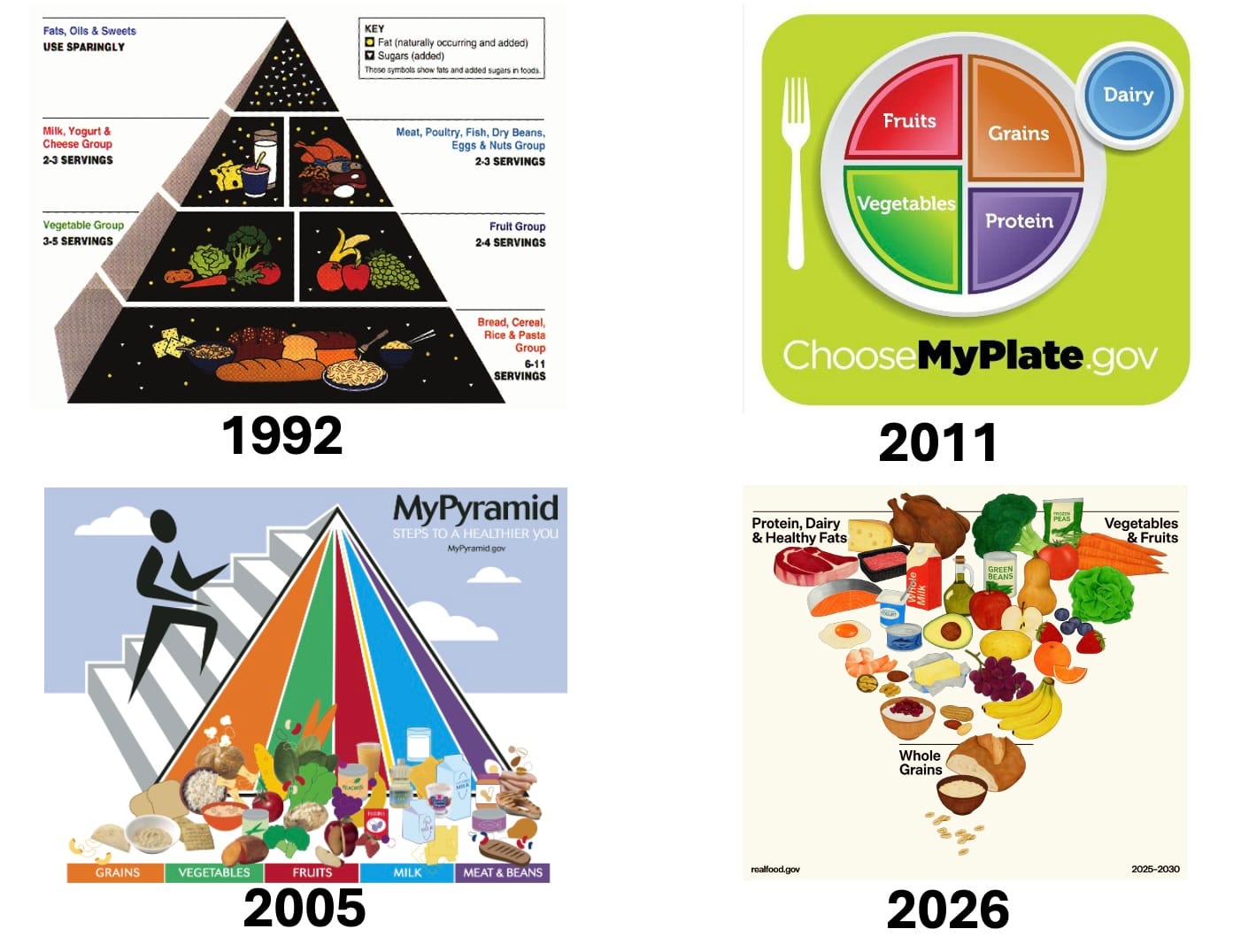
- Inverting the food pyramid as the new guidelines have, is confusing when the guideline’s key graphic places grains at the base of the inverted pyramid (i.e., minimise consumption), yet supporting text suggests otherwise.
- The US guidelines are contradictory in places, ignore opportunities to support regenerative farming, and don’t adequately push the benefits of pesticide-free, mindfully prepared, antioxidant-rich, diverse plant foods.
As we push for science-based, clinically-supported, sustainable approaches to nutrition that can start to arrest and then reverse the spiralling rates of chronic and autoimmune disease, it’s heartening to see a meaningful shift in official, government guidelines from the one of the world’s greatest superpowers.
The release of the new-for-2026, US 2025-2030 Dietary Guidelines last week, under the leadership of Robert F Kennedy Jr at the US Health & Human Services (HHS) with a helping hand from Secretary Brooke Rollins from the US Department of Agriculture, marks a pivotal step forward. There are also some side steps, some missed steps and even a stationary step as you’ll discover.
The revamped guidelines finally call out ultra-processed foods as a primary driver of chronic disease epidemics, while elevating nutrient-dense whole foods, quality red meat and other proteins, and even full-fat dairy and healthy fats, to preferred choices.
Yet, as our colleagues at ANH-USA point out in this week’s article about the guidelines on our US site, they’re laced with lingering contradictions—such as clinging to outdated saturated fat limits that clash with the science and failure to confront the deep-rooted harms of industrial agriculture. Let’s tuck in.
Long‑awaited admissions—missed opportunities
The 2025–2030 Dietary Guidelines for Americans end four decades of tone‑deaf nutrition orthodoxy. For the first time, the document highlights ultra‑processed foods (UPFs) as a leading driver of chronic disease, and tells Americans to cut back drastically. That alone is historic.
RFK Jr’s influence is clearly visible: the guidelines now acknowledge that processed, chemical‑laden diets underlie the nation’s epidemic of metabolic illness. We’d have loved to see sedentary behaviours, chemical exposures beyond food, and chronic stress induced by modern lives thrown in there as well. But while the diagnosis attempts to be frank, the prescription is still timid. The new guidance names the symptom—UPFs—without confronting the system that produces them: an industrial food economy addicted to subsidies, glyphosate, and marketing science.
Another mark of RFK Jr’s influence is the push on red meat and whole milk. But with it was a lost opportunity: to recommend that these are derived from regenerative, lower-intensity, high-welfare (including but not exclusively) organic or biodynamic farming systems. No, they could just as easily come from industrial, CAFO (concentrated animal feeding operation) farming systems. And meat and dairy from these different systems are like chalk and cheese, as are their respective impacts on human health and the environment. No mention of that. More than that, nutrition policy that’s divorced from the agricultural and food production systems that supply what most people actually eat cannot truly serve the public’s health.

“Nutrition policy that’s divorced from the agricultural and food production systems that supply what most people actually eat cannot truly serve the public’s health.”
—Rob Verkerk PhD
By contrast, Frankrijk, Duitsland, en Switzerland have already aligned their nutrition advice with whole‑food, minimally‑processed patterns. Some, like Sweden’s new Nordic Nutrition Recommendations, link health directly with planetary impact, calling for more legumes, fewer livestock products, and sustainable sourcing. Yes, they’ve all taken their EAT-Lancet medicine – and some of that medicine is downright dangerous.
The (long‑overdue) fall of ultra‑processing
For decades, US guidelines treated all “calories” as equal, quietly enabling the domination of Big Food. That era has ended—at least for now. The new document urges citizens to avoid “ready‑to‑eat, salty or sweet packaged foods” and refined starches, and tells Americans “Better health begins on your plate—not in the medicine cabinet…[defining] real food as whole, nutrient-dense, and naturally occurring”. All good.
Still missing, however, is any plan to address the addictive, engineered nature of UPFs or the economic incentives that keep them cheap and ubiquitously distributed. Nations like the UK en Sweden have begun to tackle both behaviour and environment by coupling guidance with policy on marketing, school meals and procurement standards. The US appears to be more reliant on willpower slogans like “Eat real food” (check out the new US government website, www.realfood.gov).
Protein redemption—with blinkers
After decades spent demonising red meat, the US system now admits its nutritional importance—at least biochemically. “High‑quality protein” is rightly placed at the heart (excuse the pun) of metabolic and immune health. The new intake range (1.2–1.6 g per kg) mirrors what independent researchers and health advocates have long advised and is well above the minimum requirements (0.83 g per kg) pushed by UN agencies like the Food & Agriculture Organization (FAO).
>>> De heksenjacht op rood vlees blootgelegd
But production realities are ignored. Roughly 99% of US meat, eggs, and dairy come from CAFO systems dependent on antibiotics, growth promoters and herbicide‑treated feeds. A nutrient analysis divorced from its agricultural context verges on fiction and it’s far from certain that there will be positive health benefits if that protein is derived from America’s factory farms. More than that, the new US guidelines place no upper limit on red or any other type of meat, including processed meat. We can guarantee that any 100 kg American consuming 800 g of highly processed, sodium nitrite (preservative) treated ham or salami daily will not be healthy. It’s well demonstrated too that charring your meats, especially alongside the use of sugary sauces, is a health risk and significant source of carcinogens. Yet no limit on the type of meat was given, nor was any advice given on health preparation or cooking methods, other than using butter or beef tallow for cooking. And by the way, if you eat significant amounts of meat, you’ll likely break the saturated fat cap set in the new guidelines (not to exceed 10% of daily calories). Who’s confused now?
By comparison:
- France limits red meat to ≤500 g per week; Germany, about 300 g. Both integrate environmental limits into public nutrition.
- Switzerland stresses protein diversity—mixing plant and animal sources.
- Ecuador and Australia emphasise local, minimally processed protein rather than industrial output.
In this global picture, the US message stands out for promoting meat quantity without mandating meat quality.
Grains and carbohydrates: a symbolic downsizing
The new guidance trims grain recommendations to 2 to 4 servings a day—down from the infamous “base of the pyramid” era—but then contradicts itself in other places by allowing up to eight total servings where “half should be whole.” It’s evolutionary, not revolutionary.
European peers took this step years ago: Duitsland’s and Switzerland’s pyramids centre on vegetables, legumes, nuts, and whole grains in smaller proportions, implicitly acknowledging metabolic individuality and energy density. The UK’s Eatwell Guide, though still carbohydrate‑dominant (50% of total calories), links starch quality to fibre and glycaemic effect.
Considering RFK Jr’s previously well-publicised views on pesticide residues in American food and his support for regen ag, the silence about chemical residues and soil depletion affecting those “whole grains” is both conspicuous and anomalous. Quantity has changed; quality still isn’t quantified.
Fat: the unresolved war
Perhaps the most glaring contradiction in the new US guidelines lies in fat policy.
The USDA now promotes full‑fat dairy and animal fats, signalling an end to the 1980s “low‑fat” dogma that has been widely exposed for not being science-based—yet without any explanation (scientific or otherwise) keeps the 10 % saturated‑fat limit.
As our friend and scientist Zoë Harcombe PhD and journalist Nina Teicholz have shown (here and here), that threshold makes it nigh on impossible to get compliance with everyday meals including things like eggs, yoghurt, steak and butter.
Internationally, the US stands almost alone in clinging to numeric caps.
Frankrijk en Duitsland instead focus on swapping industrial seed oils for traditional fats; Sweden accepts natural fats within plant‑rich patterns; and Switzerland prefers qualitative phrasing about oil choice, not percentages.
Modern evidence no longer supports the old cholesterol theory, and other nations have quietly updated. The latest US guidelines appear not to have made this leap—did RFK Jr perhaps find himself at an impasse, pushing against a closed door?
>>> Get sat fat happy!
>>> Tijd om vetarm in plaats van vetrijk te demoniseren?
>>> ANH Science Check – Low fat debunked
Fruit & veg: steady, sensible, uncontroversial—but still not right
On fruits and vegetables, the new guidelines hew closely to long‑standing mainstream scientific consensus. Americans are advised to eat at least five servings a day, distributed across meals — guidance that has remained virtually unchanged for decades of public‑health campaigns.
The advice itself fails to take into account the differences between fruits and vegetables in their physiological effects, nutrient density, and glycaemic impact, as well as the broader factors that determine produce quality — from soil health and pesticide load to cultivation methods and even how foods are prepared in your kitchen or different types of restaurant or fast food outlet.
Neither do they differentiate between different types of vegetable, such as starch-rich tubers like potatoes versus fibre-rich above-ground vegetables. Similarly, fruit are seen as homologous group, giving the impression that blackberries and bananas have similar effects on the body—which just isn’t the case. And then, what about the form you consume them in? If they were whole and then juiced, does that change the health profile of the fruit? How are the fruit grown, when are they picked? How long are they stored? What about canned fruits? We know from a substantial body of food analysis that these fruits and vegetables, in their multitude of forms, prepared in a multitude of different ways, can yield dramatically different effects on health, with these effects differing—sometimes even more dramatically—person to person.
>>> Eet een Regenboog omwille van uw darmen!
The missing piece: agriculture itself
Unlike the shift we’re beginning to see in some European guidelines, the US guidelines still treat food largely as nutrient arithmetic. There is no mention of monocultures, pesticide loading, degraded soils, antibiotic residues, or the ecological and animal welfare costs of CAFOs—despite those being defining realities of the American food chain.
The Kucinich Report and the Physician’s Committee for Responsible Medicine’s recent petition both emphasise this blind spot: nutrition guidance continues to be a marketing proxy for industrial food—driven by conflicts of interest—rather than an instrument of health policy.
European guidelines since 2020 have placed ever more emphasis on eating more plant-based foods, including proteinaceous ones, in an effort to integrate sustainability and the increasingly contentious climate narrative. Frankrijk en Switzerland include soil and biodiversity indicators, while Ecuador, as a lower-income country, refreshingly, puts food sovereignty, local crops, and cultural continuity in the foreground.
You could say that America’s nutrient‑only frame now looks a little jaded in the global landscape.
Pyramid revisited
I probably shouldn’t make too big a song-and-dance out of this, but the PR campaign surrounding the release of the 2025-2030 US Dietary Guidelines appears to focus heavily on the pyramid inversion that’s occurred. The RealFood.Gov website fails to mention that the original 1992 pyramid was substituted for MyPyramid in 2005, and that was in turn swapped out for MyPlate in 2011.
So for the best part of 15 years there has been no pyramid—nada. The earlier models were consigned to the bin. So you argue that the talking point should be that RFK Jr and Brooke Rollins from USDA brought the pyramid back from the dead—turned it upside down and then did some re-arranging of contents. From there we can go on to its flaws and contradictions that I’ve discussed elsewhere in this piece.
How the United States guidelines compare
| Country/Region | Plant‑based emphasis | Red‑meat stance | Fat stance | Carb stance | Distinctive feature |
| France1 | High | ≤ 500 g/ week | Moderate, oils preferred | High (starches each meal) | Culturally rooted, anti‑UPF |
| Germany2 | Very high | ~300 g/ week | Unsaturated preferred | Whole‑grain high | Merges health + climate |
| Switzerland3 | High | 2–3 portions/ week | Oil‑rich, low butter | Whole‑grain base | Protein diversity |
| Sweden4 | Very high | ~350 g/ week | Moderate | High fibre | Sustainability explicit |
| UK5 | High | Moderate‑ laag | Unsaturated | High | Behaviour and environment focus |
| Australia6 | Moderate | Moderate | Moderate | Moderate‑high | Pattern‑based, pragmatic |
| Ecuador7 | Moderate | Moderate | Low‑moderate | Traditional staples | Local, cultural & anti‑UPF |
| United States (2025–2030)8 | Moderate | High‑normal; no limit | 10 % cap preserved | Moderate‑low | Protein‑centric; industrial farming blind spots |
Footnotes:
- France: https://www.anses.fr/en/content/anses-updates-its-food-consumption-guidelines-french-population
- Germany: https://www.dge.de/english/fbdg/
- Switzerland: https://www.blv.admin.ch/blv/en/home/lebensmittel-und-ernaehrung/ernaehrung/empfehlungen-informationen/schweizer-ernaehrungsempfehlungen.html
- Sweden: https://www.livsmedelsverket.se/om-oss/press/pressmeddelanden/nya-kostrad-med-fokus-pa-mer-gront-och-mindre-sott/
- UK: https://www.food.gov.uk/business-guidance/the-eatwell-guide-and-resources
- Australia: https://www.eatforhealth.gov.au/sites/default/files/files/the_guidelines/n55a_australian_dietary_guidelines_summary_130530.pdf
- Ecuador: https://www.fao.org/nutrition/education/dietary-guidelines/regions/ecuador/en/
- United States (2025-2030): https://realfood.gov.
At the crossroads
The new US guidelines mark a partial break from past dogma, but the world has already moved further, not necessarily always in the right direction, either. Key drivers of recent updates to dietary guidelines outside of the US include framing nutrition within climate goals, ecology, transparency, and tradition. America still frames it within macros, marketing, and industry tolerance. Was it because RFK Jr was keen to avoid batting with the net-zero brigade, thinking he might be able to slip in his “red meat is back” guideline without upsetting the apple cart. As you’ll see below, the apple cart has been tipped up anyway.
If RFK Jr and his side kick Secretary at USDA, Brooke Rollins, are going to really try to deliver good dietary policy that carries both weight and longevity, they’re going to have do better (2027 revision anyone?). True dietary reform demands:
- Alignment of nutrition policy with regenerative agriculture
- Consideration of soil quality and agrochemical exposure
- Honest discussion and advice of addiction dynamics of UPFs
- Building campaigns to encourage home cooking, healthy food preparation and mindful eating practices, and
- Global cooperation to redefine food quality, not just quantity
Until food policy begins where real food begins—in the soil—the promise of “better health through better diet” will remain half‑fulfilled. And the US Dietary Guidelines will remain incapable of Mak[ing] America Healthy Again (MAHA).
What others are saying
There’s been a plethora of articles issued on the new US Dietary Guidelines. Here’ s a sprinkling with different perspectives:
Generally positive
- USDA Press Release: Kennedy, Rollins Unveil Historic Reset of U.S. Nutrition Policy https://www.usda.gov/about-usda/news/press-releases/2026/01/07/kennedy-rollins-unveil-historic-reset-us-nutrition-policy-put-real-food-back-center-health (Official announcement framing it as a major positive reform.)
- White House: WHAT THEY ARE SAYING: Trump Administration Puts Real Food First https://www.whitehouse.gov/articles/2026/01/what-they-are-saying-trump-administration-puts-real-food-first-in-dietary-guidelines (Compiles supportive quotes from health policy figures and industry groups.)
- AMAC: Real Food Starts Here: New 2026 U.S. Dietary Guidelines https://amac.us/newsline/lifestyle/real-food-starts-here-new-2026-u-s-dietary-guidelines (Praises the shift toward whole foods and protein as a historic common-sense change.)
- AJMC: USDA and HHS Update Dietary Guidelines to Encourage Real Food, Less Sugar https://www.ajmc.com/view/usda-and-hhs-update-dietary-guidelines-to-encourage-real-food-less-sugar (Positive on simplifying healthier eating with focus on whole foods.)
Critical or highlighting concerns:
- NPR: RFK Jr.’s new dietary guidelines end ‘the war on saturated fats’ https://www.npr.org/2026/01/07/nx-s1-5667021/dietary-guidelines-rfk-jr-nutrition (Quotes experts disappointed in prioritizing red meat and saturated fats over decades of evidence.)
- Harvard T.H. Chan School of Public Health: Understanding the new Dietary Guidelines https://hsph.harvard.edu/news/understanding-the-new-dietary-guidelines-for-americans (Critiques “protein hype,” saturated fat contradictions, and deviations from science.)
- CNN: New US dietary guidelines urge less sugar, more protein – and make a nod to beef tallow https://www.cnn.com/2026/01/07/health/dietary-guidelines-rfk-maha (Notes concerns from experts about favoring animal proteins over plant-based.)
- STAT News: Panel behind new dietary guidelines had financial ties to beef, dairy industrieshttps://www.statnews.com/2026/01/07/new-dietary-guidelines-review-panel-financial-ties-beef-dairy-industry (Highlights criticism of industry ties and elevation of meat/dairy.)
- Council for Responsible Nutrition (CRN): CRN Applauds HHS and USDA for Recognizing Role of Dietary Supplements in New Dietary Guidelines https://crnusa.org/newsroom/crn-applauds-hhs-and-usda-recognizing-role-dietary-supplements-new-dietary-guidelines (Applauds guidelines’ support dietary supplements and nutrient-dense foods).
Neutral (positive and negative):
- PBS News: Here’s what’s in new dietary guidelines from the Trump administrationhttps://www.pbs.org/newshour/health/heres-whats-in-new-dietary-guidelines-from-the-trump-administration
- ABC News: RFK Jr. releases new dietary guidelineshttps://abcnews.go.com/Health/white-house-releases-new-dietary-guidelines-encouraging-americans/story?id=128976128
- Associated Press: New dietary guidelines urge Americans to avoid processed foodshttps://apnews.com/article/dietary-guidelines-health-agriculture-federal-nutrition-2d8fa56be3c5900fc45116af7c69d786
Please share this article widely. Information is power: the more you understand about nutrition, the greater your ability to build lasting health, resilience and vitality.
>>> Als u nog niet bent ingeschreven voor de wekelijkse nieuwsbrief van ANH International, schrijf u dan nu gratis in via de knop SUBSCRIBE boven aan deze pagina. onze website - of nog beter - lid worden van Pathfinder en word lid van de ANH-Intl stam om te profiteren van voordelen die uniek zijn voor onze leden.
>> Voel je vrij om te herpubliceren - volg gewoon onze Alliance for Natural Health International Richtlijnen voor herpublicatie
>>> Stuur terug. naar de ANH International homepage
