
Date:20 November 2025
Treść Sekcje
- ● Understanding circadian rhythms: The body’s internal clock
- ● The far-reaching consequences of poor sleep
- ● Rebalancing the clock: Restoring sleep the natural way
- ● Reclaiming rest as a health priority
By Chimnonso Onyekwelu with Melissa Smith
A global sleep crisis is unfolding quietly, and even worsening, while few are paying attention. Reports show that in the UK, around one in three adults (33–37%) experience insomnia, with nearly 2.5 million living with obstructive sleep apnoea. In the US, about 70 million Americans have a sleep disorder, and over the past five decades, average sleep duration has dropped by two hours per night, with the number of people regularly sleeping less than six hours increasing by around 6% since 1985.
This is deeply concerning considering that humans were designed to spend nearly one-third of their lives asleep. Sleep is not a luxury; it is a biological necessity that sustains both body and mind. It plays a vital role in restoring brain function, regulating metabolism, and maintaining immune, cardiovascular, and endocrine balance.
A 2023 study shows that sleep, alongside diet and exercise, is one of the three pillars of health—essential for emotional stability, cognitive performance, health resilience and longevity. Yet, modern lifestyles have thrown this delicate system seriously out of kilter.
Our bodies are governed by circadian rhythms—intricate internal clocks that time the release of hormones, digestion, temperature, and sleep–wake cycles. Studies (here and here) show that when these rhythms are disrupted, whether by late-night screen exposure, irregular work schedules, or chronic stress, the consequences ripple far beyond tiredness. They quietly erode immunity, mood, and metabolism, setting the stage for disease.
If sleep is so foundational and we’re getting so much less of it, let’s look at why this might be and how to improve our sleep. This article explores the rising epidemic of poor and insufficient sleep—its hidden dangers, the central role of our circadian clock in governing rest and recovery, and how natural sleep optimisation strategies can help reset the body’s rhythm and reclaim truly restorative sleep.
Understanding circadian rhythms: The body’s internal clock
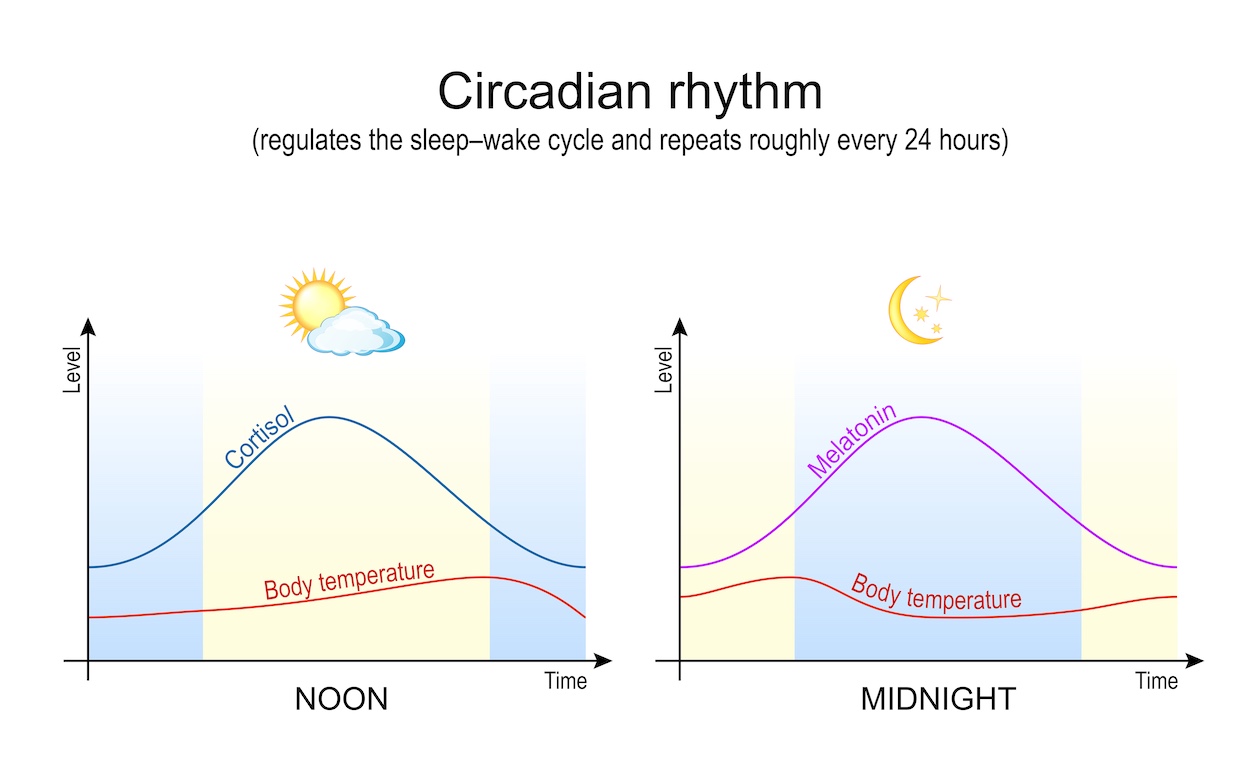
To understand why poor sleep is becoming increasingly common, we must first look at the system that determines when humans sleep and wake—the circadian rhythm. Derived from the Latin words “circa” (around) and “diem” (a day), circadian rhythms are 24-hour biological cycles that align the body’s internal processes with the natural rhythm of light and darkness. This internal clock is governed by a tiny region in the brain called the suprachiasmatic nucleus (SCN), which responds to light signals and synchronises nearly every physiological system in the body.
These rhythms regulate a remarkable range of functions—from the sleep-wake cycle, hormone release, and body temperature to metabolism, immune response, and cognitive performance.
As night falls, and darkness ensues, the brain is designed to release melatonin, a hormone that promotes sleepiness, while body temperature drops to encourage rest. At dawn, exposure to light suppresses melatonin and raises cortisol levels, triggering alertness and energy.
However, modern lifestyles have disrupted this delicate harmony. Artificial light, late-night screen exposure, irregular meals, stress and shift work all confuse the body’s internal clock. The result is more than just fatigue. This rhythm disruption affects mental clarity, mood, immunity, and long-term health, with consequences that echo far beyond the night.
It’s interesting to note, that in Medieval times sleep was commonly biphasic – in two halves – known as first and second sleep. Rather than a single eight hour block people would get up in the middle of the night and get stuff done before going back for more sleep. The introduction of artificial lighting changed our sleeping patterns to what we know today.
The far-reaching consequences of poor sleep
Insufficient sleep costs the UK economy between £30 and £50 billion every year—and a staggering $411 billion in the United States. These losses stem from reduced productivity, absenteeism, workplace errors, and increased accident rates. But beyond the economic toll lies a deeper crisis: the profound biological, psychological, and emotional consequences of chronic sleep deprivation. Sleep is often the first thing people sacrifice when trying to squeeze more into the day, yet it remains one of the most essential pillars of human health.
A meta-analysis of 19 studies found that partial sleep deprivation alters mood more severely than it does cognitive or motor performance. Another study reported that among more than 3,000 high school students, inadequate sleep was linked with depression, anxiety, behavioural issues, alcohol use, and suicidal thoughts. Likewise, a three-year longitudinal study of 2,200 adolescents found that persistent sleep loss predicted lower self-esteem and worsening mood over time. Together, these studies reveal that emotional and behavioural health are often the first to decline when sleep is sacrificed.
Biologically, sleep deprivation sets off a cascade of harmful effects. It raises cortisol, the body’s main stress hormone, while impairing fat metabolism and glucose regulation—a pathway that leads to obesity, diabetes, and hypertension. Workers who sleep fewer than six hours per night face a fourfold increased risk of stroke and chronic conditions such as heart disease, inflammation, and immune dysfunction become markedly more common. Studies (here and here) also link short sleep duration with higher all-cause mortality, forming a U-shaped curve of risk where both too little and too much sleep can shorten lifespan.
Cognitively, sleep loss impairs the brain much like alcohol intoxication. One study showed that being awake for 17 hours produces deficits equivalent to a blood alcohol level of 0.05%—the legal driving limit in many countries. After 24 hours, impairment doubles to 0.10%. Chronic deprivation dulls attention, slows reaction time, weakens memory, and erodes decision-making. Effects that ripple across workplaces, classrooms, and homes alike.
At its core, insufficient sleep disrupts every system that sustains human health; from immunity to metabolism, mood, and cognition. It is not merely about feeling tired; it is a slow unraveling of balance within the body and mind, one restless night at a time.
Rebalancing the clock: Restoring sleep the natural way
While sleeping pills can provide short-term relief, true and lasting restoration lies in addressing what’s throwing the body’s natural rhythms off balance. Restful sleep is not merely about closing one’s eyes; it’s about re-synchronising the body’s internal clock with the natural cues of light, temperature, food, and rest. When aligned, this rhythm helps the brain clear toxins, supports memory and learning, and strengthens the immune, cardiovascular, and metabolic systems. But it takes commitment and discipline.
To restore this natural rhythm, consistency must come first.
- Aim to go to bed and wake up at the same time each day, even on weekends.
- Morning sunlight exposure helps cue wakefulness and strengthens the body’s internal clock, while dimming lights and limiting screen time in the evening allows melatonin—the body’s sleep hormone—to rise naturally. However, in order to keep melatonin at the right levels for cellular rejuvenation, cancer prevention and EMF protection (here and here), you need to sleep in a pitch dark room with zero sources of light. Your pineal gland is super sensitive and any light sources will halt the production of melatonin and its powerful health-promoting benefits.
- Creating a calm, cool, and quiet sleep environment also helps the body wind down.
- Avoid caffeine, alcohol, and heavy meals in the hours before bed, and instead, develop a gentle nighttime routine—light stretching, a bath, reading, reflection, meditation or prayer—to ease the mind into rest.
What we eat also plays a subtle but powerful role in sleep regulation.
- Nutrients such as magnesium, vitamin D, vitamin B6, zinc, and tryptophan support the production of serotonin and melatonin—hormones that regulate sleep-wake cycles.
- Foods like leafy greens, nuts, seeds, oily fish, poultry, bananas, and tart cherries naturally enhance sleep quality, while studies (here and here) have shown kiwi fruit to reduce night-time awakenings due to its rich serotonin content.
By weaving together consistent habits, calming routines, nutrient-rich foods and making good sleep a priority in your life, the body gradually relearns its natural rhythm—allowing sleep to return, not as something to be forced, but as something that flows naturally.
Reclaiming rest as a health priority
Sleep isn’t a luxury or an indulgence; it’s one of the body’s most powerful healing tools.
When we don’t get enough of it, every part of us feels the strain—our focus, mood, energy, and long-term health.
But when we make sleep a priority, everything else starts to work better. The mind clears, the body repairs, and life begins to feel balanced again.
It’s time we start valuing rest as much as we value productivity. Getting enough sleep shouldn’t be seen as laziness or a reward for a busy day; it’s a fundamental part of staying healthy and thriving. By aligning our routines with the body’s natural rhythm – sleeping and waking in tune with light, eating well, managing stress, and creating calm evenings – we allow our bodies to do what they were designed to do: restore and renew.
When we align with the body’s natural rhythm, we don’t just sleep better– we live with greater clarity, vitality, and purpose.
True rest, after all, is where real health begins.
>>> Jeśli nie są Państwo jeszcze zapisani do cotygodniowego newslettera ANH International, proszę zapisać się za darmo, korzystając z przycisku SUBSKRYBUJ na górze strony. nasza strona internetowa - lub jeszcze lepiej - zostać członkiem Pathfinder i dołączyć do plemienia ANH-Intl, aby cieszyć się korzyściami unikalnymi dla naszych członków.
>> Prosimy o ponowną publikację - wystarczy śledzić naszą stronę Alliance for Natural Health International. Wytyczne dotyczące ponownej publikacji
>>> Powrót do strony głównej ANH International
